
Signing up for a bank because it plants trees sounds like a no-brainer. The Aspiration Spend & Save account makes that pitch feel effortless and modern.
But the gap between Aspiration’s marketing and the actual account terms is wider than any competitor comparison will tell you. That gap lives in the spending requirements.
If you care about where your deposits go and want a debit-card-first banking setup, this review breaks down what the numbers look like once you stop reading the headlines.
The Rebrand Nobody Expected: Aspiration Is Now GreenFi
The single biggest piece of context for anyone researching this account in 2026 is the name change.
Aspiration rebranded to GreenFi on April 22, 2025. The product itself, the Spend & Save account, still works the same way. But the branding, app interface, and some of the terminology have shifted.
GreenFi is not a bank. It works with Coastal Community Bank to offer its banking accounts and deposit products.
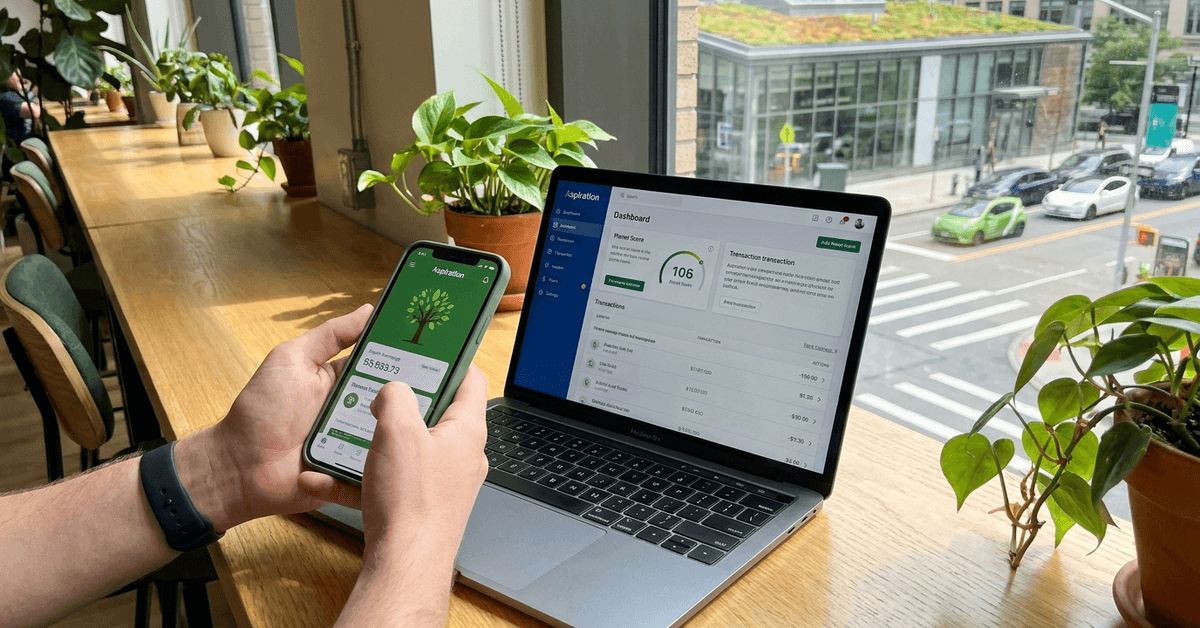
This is a detail that matters at tax time, when filing disputes, or when checking FDIC coverage limits. Deposits are protected by FDIC insurance up to $1.25 million through Coastal Community Bank’s banking sweep program.
What Changed After the Rebrand
The core account structure stayed intact. GreenFi offers the Checking and Savings account, which has both spending and savings features.
The “pay what is fair” model, the Conscience Coalition (now called the Green Marketplace in some places), and the environmental commitments all carried over. Basic account customers earn 3% cash back, and GreenFi Plus customers earn 6% cash back at participating retailers.
So if you see old articles referencing “Aspiration” and new ones saying “GreenFi,” they’re talking about the same product. The account did not reset, merge, or change banks during the transition.
The APY Looks Great Until You Read the Requirements
This is where I think the standard advice to “just pick the highest APY” falls apart for Aspiration/GreenFi specifically.
The advertised rate is up to 5.00% APY on the Plus plan. That number catches eyes. But the conditions attached to it make it unreachable for a surprising number of users.
How the Interest Tiers Break Down
To earn the top APY on Save Account balances up to $10,000 in any calendar month, customers must have settled debit card transactions of $500 or more with their Aspiration debit card. That $500 floor applies to the basic plan. Plus accounts require $1,000 a month in debit card spending to qualify for the highest rate.
Miss that threshold in any given month? The APY drops to 0.00% for basic accounts or 0.25% for Plus subscribers. And the higher rate only applies to the first $10,000 in savings. Balances over $10,000 earn 0.00% APY for standard users and 0.25% for Plus members.
I would argue that an account advertising “up to 5% APY” while paying 0% to anyone who spends less than $500 per month on a debit card is misleading in practice, even if it is technically accurate. A bank like SoFi or Wealthfront will pay you interest on your balance regardless of how often you swipe a card. Aspiration/GreenFi penalizes savers who prefer credit cards for daily purchases.
What $500 in Monthly Debit Spending Looks Like
Debit card transactions for money transfer vendors like CashApp, Venmo, and Facebook Pay do not qualify towards the $500 spend requirement. That cuts out a common workaround right away.
So the $500 needs to come from regular retail spending: groceries, gas, subscriptions, dining.
For someone who runs all their spending through a credit card for points and only keeps a checking account for bills, this requirement turns the savings APY into dead weight.
Aspiration Plus: Is $7.99 a Month Worth It?
The paid tier unlocks everything Aspiration/GreenFi advertises in its marketing. Aspiration Plus costs $7.99 per month, or $5.99 per month if paid annually. That comes out to roughly $72 to $96 per year depending on billing.
The Plus plan gets you the higher APY ceiling, better cash back rates at Green Marketplace merchants, and carbon offset features for driving. Plus accounts can earn up to 5% APY on the first $10,000 in savings, assuming the $1,000 monthly debit spend threshold is met.
A comparison across the two tiers looks like this:
| Feature | Basic (Pay What Is Fair) | Aspiration Plus |
|---|---|---|
| Monthly Fee | $0 (voluntary) | $7.99/mo or $5.99/mo annually |
| Max Savings APY | Up to 3.00% | Up to 5.00% |
| APY if spending minimum not met | 0.00% | 0.25% |
| Cash Back (Green Marketplace) | 3% | Up to 6-10% |
| Monthly Debit Spend Required | $500 | $1,000 |
| FDIC Coverage | Up to $1.25 million | Up to $1.25 million |
The takeaway: Plus only makes financial sense if you consistently spend $1,000+ per month on the debit card and keep close to $10,000 in savings.
The math question is simple: does the extra interest earned on up to $10,000 justify the annual fee? On $10,000 at 5% APY, that is $500 per year in interest. Subtract the $72 annual fee (paid yearly) and you keep $428.
At the basic plan’s 3% APY ceiling with no fee, $10,000 earns $300. So the Plus plan nets about $128 more per year. That assumes you hit the spending minimum every single month, which is the part people skip over.
The “Pay What Is Fair” Model and Who It Serves
On paper, letting customers choose their own fee sounds progressive. The contribution is completely at the customer’s discretion and can be as little as $0.00. Some users pay nothing. Others contribute a few dollars a month.
But think about what this means structurally. The free-tier account earns 0% APY if you miss the debit spending threshold. No interest, no monthly fee, but also very little reason to keep money in the Save portion of the account. The “pay what is fair” model works best as a gateway: get users in the door at $0, then convert them to Plus once they realize the free tier has minimal savings benefits.
I don’t think that is dishonest. But I do think the framing of “pay what is fair” obscures the fact that the free account is a checking account with an optional, high-friction savings feature bolted on.
Practical Limitations to Check on the Aspiration Website
The environmental mission is the selling point, and it is real. Deposits will not fund research and production of fossil fuels. Tree planting, carbon offsets, and the Green Marketplace partnerships give users concrete ways to direct spending toward brands that meet environmental criteria.
But the account has practical limitations that trip up new users expecting a full banking replacement:
- No cash deposits at all. Other online banks let you deposit cash through ATMs or retail partners. Aspiration doesn’t do that. You simply cannot deposit cash into your account.
- No overdraft protection. GreenFi doesn’t allow overdrafts, so if your balance runs short, the transaction gets declined. No fee is charged, but the card just stops working.
- Limited international use. Debit card transactions don’t work in every country, so check GreenFi’s list of blocked countries before traveling.
- App reliability complaints. Many users report having difficulty with the interface, and there seems to be inconsistency in when deposits are processed and become available.
These are not dealbreakers for everyone. But someone who handles cash income regularly, travels internationally, or needs overdraft as a safety net should factor these in.
Who Should Actually Open This Account
The Aspiration Spend & Save account (now GreenFi Checking and Savings) works well for a specific profile: someone who already spends $500 to $1,000 per month on a debit card, keeps under $10,000 in liquid savings, banks entirely online, and wants their deposits excluded from fossil fuel investments.
It is a poor fit for high savers. Parking $50,000 in this account earns the top APY on only the first $10,000, and the rest earns almost nothing. A FDIC-insured high-yield savings account at a competitor like Marcus or Ally would earn interest on the full balance without spending requirements.
It is also a poor fit for credit card optimizers. If your primary spending goes through a rewards credit card, meeting the debit spend threshold each month requires either redirecting spend (and losing credit card rewards) or artificially running purchases through the debit card. Neither option makes financial sense.
Questions People Ask About Aspiration Spend & Save
These are the questions that come up once someone gets past the marketing page and starts looking at the fine print.
- Q: Did Aspiration change its name?
Aspiration rebranded to GreenFi on April 22, 2025. The Spend & Save account still exists under the GreenFi name, with the same features and banking partner. Old Aspiration accounts transitioned automatically. - Q: Can I earn the advertised 5% APY without Aspiration Plus?
No. The basic plan caps at 3% APY on savings, and that rate requires $500 in monthly debit card purchases. Miss the spending minimum and the rate drops to 0%. - Q: Does Aspiration charge overdraft fees?
There are no overdraft fees because the account does not allow overdrafts at all. If your balance is too low for a transaction, the purchase gets declined at the point of sale. - Q: Is the cash back program worth switching banks for?
The cash back only applies at Green Marketplace (formerly Conscience Coalition) merchants, not everywhere. If the brands on that list match your regular spending, the 3% to 10% rates are competitive. If they don’t, the cash back will be minimal regardless of which tier you choose. - Q: Are Aspiration deposits FDIC insured?
GreenFi works through Coastal Community Bank, which is FDIC insured. Coverage extends up to $1.25 million per depositor through the bank’s sweep program, which is higher than the standard $250,000 at a single institution.
Conclusion
The green banking pitch from Aspiration, now GreenFi, has a real mission behind it and real products attached. The spending requirements to earn the advertised APY are stricter than those of competing online banks.
For debit-card-heavy spenders who want fossil-fuel-free deposits, the account fills a niche nothing else does. Everyone else should run the math on the spending minimums before assuming the headline rate applies to them.