
Running an online store that ships to three countries means dealing with three currencies, three payment processors, and three sets of foreign transaction fees eating into margins nobody budgeted for.
The Airwallex Business Card keeps showing up in fintech recommendation threads. But the conversation around it skips the parts that matter to sellers managing ad spend, supplier invoices, and payroll across borders.
This review is built for e-commerce operators and international sellers. Not generic “small business owners,” but people whose profit margins live and die by FX conversion costs.
The Multi-Currency Problem That Kills E-Commerce Margins
Every cross-border seller knows the frustration. A supplier in Shenzhen invoices in USD. A Facebook ad campaign bills in EUR.
Shopify deposits land in AUD. And a traditional business bank card charges 2% to 3.5% on every international transaction, quietly compressing already tight margins on each order.
That recurring bleed is where Airwallex positions its card. The Airwallex business account lets companies hold balances in 11 major currencies including USD, EUR, GBP, AUD, JPY, CAD, and MXN.
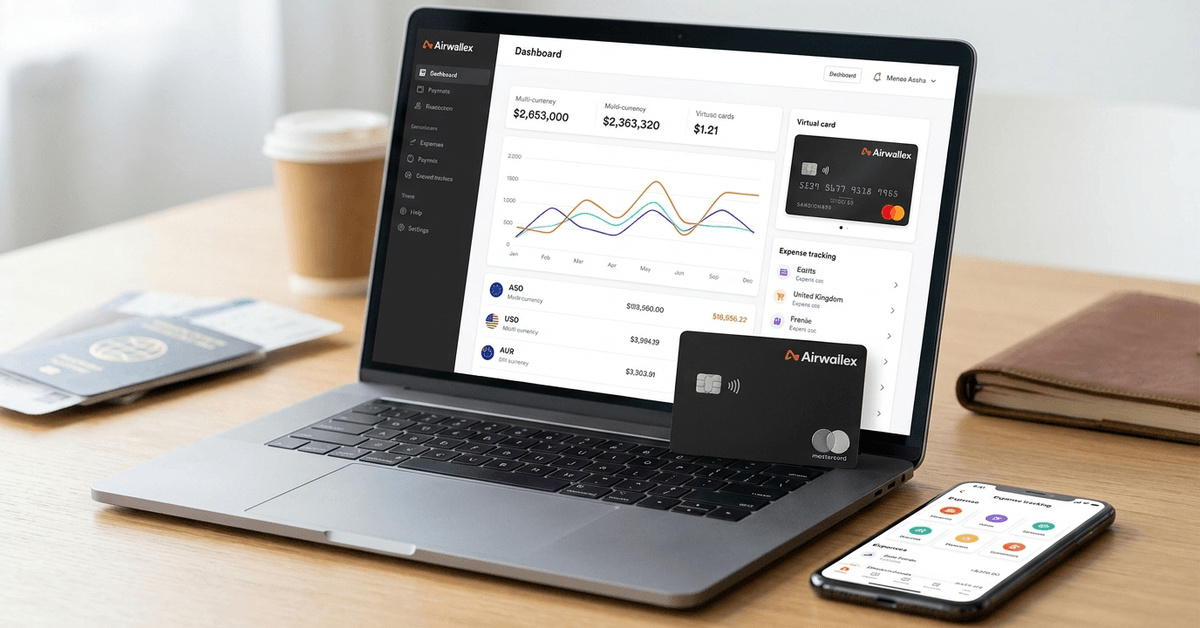
Spend from a held balance in the same currency as the transaction, and there is no conversion fee at all. When conversion is needed, Airwallex charges 0.4% to 0.6%, which sits well below the standard bank markup.
I think a lot of sellers fixate on the wrong number when comparing cards. The advertised FX rate grabs attention, but the fee that hits hardest is the one charged on ad spend.
A store running $20,000 per month in Meta and Google ads through a card with a 2.5% foreign transaction fee loses $500 monthly. At Airwallex’s 0.5% average, that same spend costs roughly $100 in conversion. The $400 difference per month is $4,800 annually, and that figure alone pays for a lot of operational software.
Why Ad Spend Is the Real Test for a Business Card
A card can look great for office supplies and subscriptions. The test comes when marketing teams push $10,000 or $50,000 a month through Meta, Google, and TikTok ad accounts.
Airwallex lets teams create unlimited virtual cards tied to individual campaigns or ad accounts, each with its own spend limit and merchant restrictions. That separation matters more than convenience. If a virtual card number leaks or gets compromised on one platform, the damage stays contained to that single card.
Freeze it, spin up a new one, keep every other campaign running. Compare that to a single shared corporate card where one breach shuts down all paid advertising while the finance team sorts it out.
Airwallex Virtual Cards vs Physical Cards: What Gets Issued and When
Both virtual and physical Visa cards are available through the platform, but they function differently depending on whether the card is a company card or an employee card.
Company cards carry the business name and are intended for shared purchases: software subscriptions, supplier payments, office supplies. These are virtual-only as of mid-2026.
Employee cards get issued to individual team members for travel, meals, or project-specific spending, and these come in both virtual and physical formats.
Card Limits and Free Tier Caps
The first five cardholders are included free on all Airwallex plans. Each additional cardholder after that costs around $5 per month. That pricing can sneak up on growing teams.
A company issuing cards to 20 employees would pay roughly $75 monthly in cardholder fees beyond the free tier. Default transaction limits sit at $50,000 USD equivalent per card. Lowering limits can be done instantly through the dashboard. Raising them requires contacting support.
And a detail worth checking: ATM cash withdrawals are not available on UK Airwallex cards, and availability varies by region. For businesses that occasionally need physical cash for on-the-ground expenses in certain markets, a backup solution is necessary.
Expense Tracking and Accounting Integrations
Airwallex connects card transactions directly to its expense management platform, showing purchases in real time rather than waiting for monthly statements. Employees can snap receipt photos on mobile, and finance teams approve or flag expenses from the same dashboard.
The accounting integrations cover Xero, QuickBooks, and NetSuite, with a Spend API released in early 2026 for companies that want to build custom connections to other ERPs.
The March 2026 update also added an AI Assistant to the web app that can open global accounts, create cards, and answer questions about account status without switching screens.
The Reconciliation Shortcut Nobody Talks About
I would pick Airwallex over Wise Business or Revolut Business for one specific reason: the ability to issue a separate virtual card per vendor or per ad platform and then map each card directly to an accounting category.
When a Meta ad card only ever charges Meta, reconciliation becomes automatic. No sorting, no categorizing, no matching transactions to invoices after the fact.
That approach eliminates what I think is the biggest hidden cost in cross-border e-commerce bookkeeping: the hours spent each month manually categorizing international transactions across mixed-use cards. A finance team spending 10 hours a month on reconciliation at $50/hour burns $6,000 annually on a problem that virtual card segmentation solves at issuance.
Airwallex Business Card vs Wise vs Revolut Business
Comparing these three platforms across the same criteria shows where each one fits and where it falls short:
| Feature | Airwallex | Wise Business | Revolut Business |
|---|---|---|---|
| FX conversion fee | 0.4% to 0.6% | 0.33% to 3.56% (varies by pair) | 0% to 1.5% (depends on plan) |
| Foreign transaction fee | None on same-currency spend | None on same-currency spend | None to 1% depending on plan |
| Free cards included | 5 cardholders | 3 cards (UK) | Varies by plan |
| Virtual card creation | Unlimited | Limited by plan | Limited by plan |
| Accounting integrations | Xero, QuickBooks, NetSuite, API | Xero, QuickBooks | Xero, QuickBooks, FreeAgent |
| Supported currencies held | 11 | 40+ | 25+ |
Wise holds more currencies, and for businesses that transact in exotic pairs, that breadth matters. But for sellers focused on major trading currencies and high-volume ad spend, Airwallex’s unlimited virtual cards and lower per-card cost give it an edge.
Revolut Business works well for European-focused SMEs, though its card limits tighten on lower-tier plans.
Signing Up and Getting Verified
The onboarding process runs entirely online. Only legally registered businesses qualify. Sole proprietors and unregistered freelancers are out.
Airwallex requires business verification documents including proof of registration, director identification, and sometimes articles of association or ownership structure charts.
Approval typically takes one to three business days for straightforward company structures. Complex ownership arrangements or businesses registered in higher-risk jurisdictions may face longer review periods. A few things to check before applying:
- Confirm that Airwallex operates in your country. The platform covers 50+ countries for card issuance, but availability of specific features varies by region.
- Prepare your company registration documents, director ID, and proof of business address before starting.
- Check whether your plan tier includes enough free cardholders for your team size, or budget for the per-cardholder fee.
- Review the PCI Security Standards Council guidelines if your business handles stored card data, since Airwallex maintains PCI DSS compliance for its own infrastructure but your internal processes need to match.
Limitations That Might Be Dealbreakers
No product fits every business, and Airwallex has specific gaps worth flagging:
- No cash withdrawal on UK cards, and limited ATM access in other regions
- Only 11 held currencies compared to Wise’s 40+. Sellers doing business in Thai baht, Nigerian naira, or other less common currencies will need a separate solution.
- Third-party API integration lag occasionally occurs when platforms like Xero push updates. Double-check synced data during periods when your accounting software rolls out major changes.
- Physical card shipping delays affect certain regions, so plan ahead if employees need physical cards for travel.
Questions People Ask About the Airwallex Business Card
These are the searches that keep coming up around this card.
- Q: Does the Airwallex Business Card charge foreign transaction fees?
No fee applies when spending from a held balance in the same currency as the transaction. If a conversion is needed, the fee runs between 0.4% and 0.6%. That auto-conversion kicks in when your balance in the required currency is insufficient, pulling from your home currency at the platform’s exchange rate. - Q: Can I use the Airwallex card for personal expenses?
The card is strictly for business use. Airwallex issues cards only to registered business account holders, and spending controls are tied to business policies set by account admins. Mixing personal and business spend on these cards would create accounting headaches and potentially violate the terms of service. - Q: How many Airwallex virtual cards can I create?
There is no cap on the number of virtual cards. The limit applies to cardholders, not cards. The first five cardholders are free, and each additional one costs approximately $5 monthly. A single cardholder can have multiple virtual cards assigned to different purposes. - Q: Is Airwallex better than Brex for international businesses?
Brex requires a $25,000 minimum cash balance in a connected US bank account. Airwallex has no minimum balance requirement. For companies outside the US or those without large cash reserves, Airwallex removes a barrier that Brex enforces strictly. Brex also focuses heavily on the US market, while Airwallex operates across 50+ countries. - Q: Does Airwallex work with Apple Pay?
Employee cards can be added to Apple Pay, Google Pay, and other digital wallets. Company cards are virtual-only but can also be linked to digital wallets for contactless payments. Apple Pay support expanded to New Zealand in May 2026.
Conclusion
The Airwallex Business Card fits e-commerce sellers and international teams who want granular control over multi-currency spend.
Unlimited virtual cards, low FX fees, and direct accounting integrations solve specific problems that traditional bank cards create.
The free tier works for small teams, though growing companies should budget for per-cardholder costs beyond five users. For any seller bleeding money on foreign transaction fees across ad platforms, this card deserves a serious look.