A new autónomo registration lands in your inbox. The next question: where does the money go? Picking the wrong card costs more than fees. It costs hours every quarter at tax time.
Cards for freelancers in Spain split into two camps now. Legacy banks sell autónomo packages. Fintechs sell speed and low FX rates. Both sides leave gaps.
This guide breaks down what those gaps look like and which card setups save real money for remote workers billing international clients from Spanish soil.
Why the “Get a Spanish Bank Business Card” Advice Falls Apart
The default recommendation on every Spain freelancer forum goes something like this: open an account at BBVA or CaixaBank, get their autónomo card, and call it done.
I think that advice costs freelancers billing in USD or GBP an extra €200 to €400 per year in foreign transaction fees alone, based on typical 1.5% to 2% FX markups at legacy Spanish banks compared to Wise’s mid-market rate.
Traditional Spanish banks do offer autónomo-oriented cards. BBVA bundles customizable spending reports, travel insurance, and loyalty points for professional purchases. That sounds great on paper.
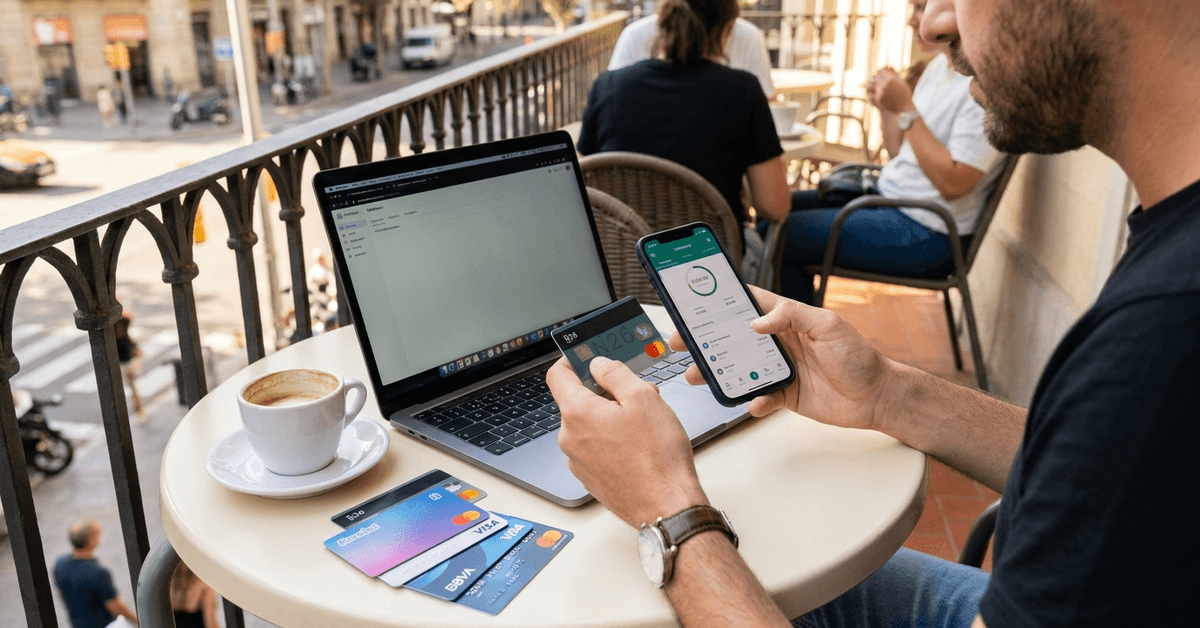
But the app experience at legacy banks still lags behind fintech competitors. Expense categorization tends to be broad (“services,” “travel,” “other”) rather than granular enough to map onto Modelo 303 VAT deduction categories.
And monthly maintenance fees can sit around €5 to €10 even after the first-year waiver expires.
The FX Fee Trap for International Freelancers
Freelancers receiving payments in foreign currencies get hit twice: once on the incoming transfer conversion rate and again on any card spending done abroad.
A legacy bank card charging 1.8% on non-euro transactions adds up fast if half your income arrives in dollars or pounds.
Wise and Revolut both offer multi-currency accounts where funds stay in the original currency until spent. Conversion happens at mid-market rates with small transparent fees. That difference on a €3,000 monthly invoice cycle can mean €40 to €50 saved each month.
Expense Export Compatibility: The Part That Costs Hours
A budgeting dashboard with pie charts looks nice. But for a Spanish autónomo filing quarterly VAT returns, the question is simpler: can the card’s transaction history export into a format that Quipu or Declarando can read?
Qonto integrates directly with both platforms. N26 Business exports transactions as CSV. Revolut offers categorized exports but sometimes requires manual cleanup before import. BBVA provides monthly statements in PDF, which means manual data entry or OCR workarounds.
I would pick Qonto over BBVA for any freelancer using Declarando, specifically because the direct integration eliminates the quarterly copy-paste ritual that eats two to three hours per filing.
Card Types That Work for Spain-Based Remote Workers
Each card type solves a different problem. The trick is matching card type to income pattern, not picking one based on a generic “best cards” list.
Debit Cards Linked to Digital Banks
N26 Business includes a Mastercard debit, categorized expense tracking, and up to 0.1% cashback on purchases.
The account opens entirely online, which appeals to digital nomads still waiting on their NIE appointment. Spending is limited to available balance, so there is zero debt risk.
The downside: debit cards offer less purchase protection than credit cards, and N26 does not issue supplementary cards for team members or collaborators.
Credit Cards for Larger Professional Purchases
A credit card makes sense for freelancers who handle periodic large expenses: equipment, conference travel, or annual software licenses.
The grace period between purchase and payment date gives breathing room during months when client invoices arrive late.
The catch is approval. Spanish banks often require proof of stable income for credit card issuance, and a new autónomo with six months of irregular invoices may face rejection. BBVA and CaixaBank both request recent tax filings (declaración de la renta) during the application process.
Prepaid Cards for Spending Caps
Prepaid cards are underrated for one specific use case: online subscriptions. Loading a prepaid card with a fixed monthly amount and linking it to SaaS tools, hosting, and ad platforms prevents surprise charges from eating into operating cash.
Some prepaid cards also let you lock and unlock the card from a mobile app. That feature matters if you work from co-working spaces or travel frequently and want to reduce exposure to unauthorized transactions.
Comparing the Top Card Providers for Freelancers in Spain
The provider landscape shifts fast, so specifics change. But as of 2026, these are the cards freelancers in Spain mention repeatedly:
| Provider | Card Type | FX Fees | Expense Export | Monthly Fee |
|---|---|---|---|---|
| N26 Business | Debit | 1.7% on non-EUR | CSV export | €0 |
| Revolut Business | Debit | Mid-market rate (limits apply) | Categorized CSV | €0 (free plan) |
| Wise | Debit | Mid-market + small fee | CSV/API | €0 (card fee applies) |
| Qonto | Debit | 1% on non-EUR | Direct Quipu/Declarando sync | From €9/month |
| BBVA Autónomo | Credit/Debit | ~1.8% on non-EUR | PDF statements | ~€5-10/month |
| BNEXT | Debit | Low FX fees | App-based | €0 |
Qonto costs more monthly but may save the equivalent in accounting hours each quarter.
Tax Compliance and Card Separation for Autónomos
The Agencia Tributaria can request detailed account records when auditing deductions. Mixing personal groceries with business software subscriptions on one card creates problems during an audit. A dedicated business card generates a clean transaction trail.
NIE, NIF, and Account Opening Requirements
Spanish banks and fintechs require a NIE (or NIF for citizens) and proof of address. Non-residents and recent arrivals sometimes struggle with traditional banks that want a certificado de empadronamiento or utility bill in your name.
Digital-first banks simplify this process. N26 and Revolut accept passport-based verification for EU citizens.
Wise requires address verification but accepts bank statements from other countries as proof. The friction varies, so checking each provider’s current requirements on their official site saves a wasted trip to a branch.
Separating Business and Personal Expenses
I would not recommend using a single card for both personal and business spending, even if the Agencia Tributaria does not technically require separate accounts.
The reason is practical: during a Modelo 303 filing, every mixed transaction needs manual classification. A second card dedicated to business purchases eliminates that sorting step entirely.
Three things to keep separated on a business card:
- Software and SaaS subscriptions billed monthly or annually (hosting, project management tools, design software)
- Travel and transport related to client meetings or co-working space commutes
- Professional services like accounting fees, legal consultations, or platform commissions
Keeping those categories on one card and personal spending on another makes quarterly tax filing a 30-minute task instead of a full afternoon.
App Features That Save Time During Tax Season
Mobile app quality differs wildly between providers. A card with a clean dashboard, live transaction notifications, and one-tap export does more for a freelancer’s sanity than cashback rewards.
Real-Time Notifications and Spending Alerts
Instant push notifications after every transaction help catch unauthorized charges within minutes. N26, Revolut, and Qonto all send real-time alerts. BBVA sends notifications too, but often with a delay that ranges from minutes to hours.
Spending alerts that trigger when a weekly or monthly category limit is reached help freelancers with irregular income avoid overspending during high-revenue months.
It sounds counterintuitive, but the months where money flows freely are when spending discipline matters.
Virtual Cards for Online Payments
Revolut and Qonto both offer virtual cards that generate a unique card number for each merchant or subscription. If a vendor gets breached, only the virtual card number is compromised. The physical card remains unaffected.
For freelancers managing multiple client projects with different tool stacks, creating one virtual card per project keeps expense tracking clean without extra bank accounts.
Questions People Ask About Cards for Freelancers in Spain
These are the questions that come up again and again in freelancer communities and tax advisory forums.
- Q: Do I need a business bank account to work as an autónomo in Spain?
Spanish law does not require a separate business account for autónomos. But the Agencia Tributaria expects clear records of deductible expenses, and a mixed-use personal account makes that harder. A dedicated card is the minimum practical step. - Q: Can I open a Wise or Revolut account without a Spanish NIE?
Both platforms accept EU passport verification for account opening. A NIE is needed for full Spanish tax compliance and for linking to Agencia Tributaria filings, but the card itself can be activated before the NIE arrives. - Q: Are fintech cards safe for holding large balances in Spain?
N26 holds a full European banking license and deposits are protected under the €100,000 deposit guarantee scheme. Revolut received its EU banking license, which gives similar protection. Wise and Qonto operate under different structures, so checking their current regulatory status at Banco de España is worth doing before parking large sums. - Q: Can I issue cards to a virtual assistant or subcontractor?
Qonto allows multiple user cards under one business account. Revolut Business also supports team cards with individual spending limits. N26 Business does not offer supplementary cards on its standard freelancer plan. - Q: Which card has the lowest fees for receiving USD payments?
Wise charges a small transparent conversion fee at mid-market rates, typically around 0.4% to 0.6% for USD to EUR. Revolut offers free conversion up to a monthly limit on paid plans. Traditional Spanish banks charge between 1.5% and 2.5%, making them the most expensive option for dollar-denominated income.
Conclusion
Picking the right freelancer card in Spain is less about brand loyalty and more about fee structures. The card that exports cleanly into your accounting software saves more than any cashback program.
Separating business spending on a dedicated card turns quarterly tax filing from a chore into a checklist. And for 2026, the fintech options keep pulling further ahead of legacy banks on price and usability.