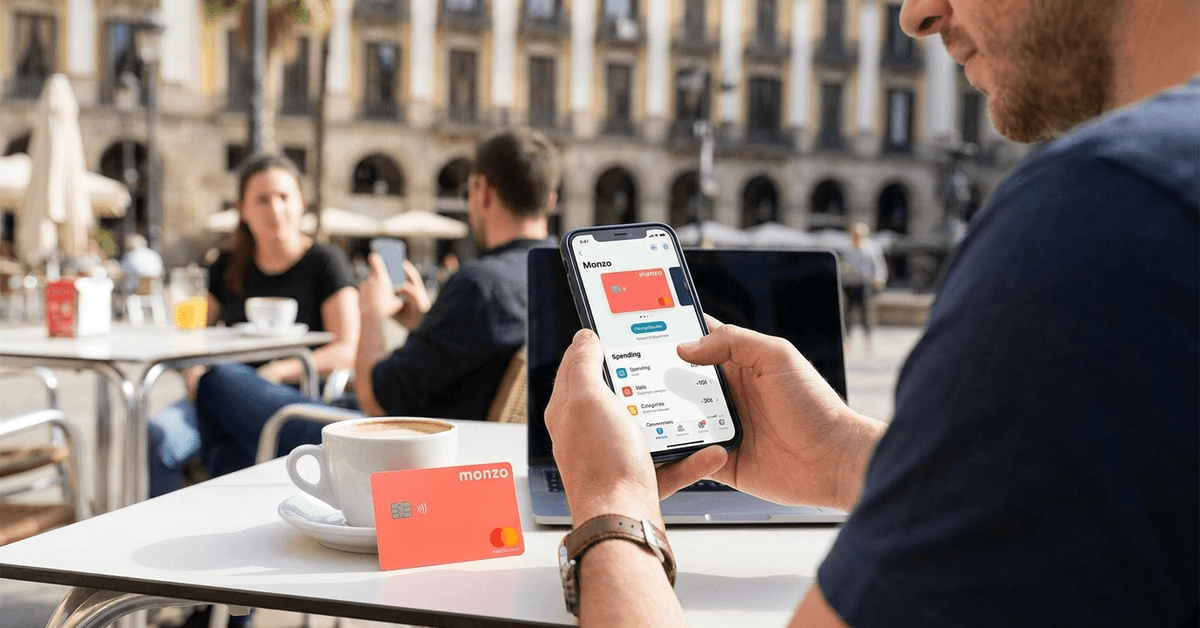
A €3.50 café con leche in Lisbon costs you €3.60 after your Spanish bank takes its cut. That ten cents is invisible until it multiplies across a year of border-hopping.
No foreign transaction fee credit cards sound like an obvious fix. But the card that saves you money in Portugal might drain you at a Thai ATM.
Spain’s card market has shifted fast since neobanks arrived. Picking the wrong “fee-free” card could cost more than the old-school option you’re trying to replace.
The Exchange Rate Trick That Matters More Than the Fee Waiver
Every comparison article about no foreign transaction fee cards focuses on the fee itself: that 1-3% surcharge traditional banks slap onto non-euro purchases. And yes, killing that fee helps.
But I think the exchange rate markup on cards like Revolut during weekend trading windows matters more than the transaction fee waiver itself, because Revolut adds a weekend FX surcharge that can reach 1% on top of the mid-market rate.

A card advertising zero foreign transaction fees can still use a conversion rate set by the issuer rather than the interbank mid-market rate.
The gap between those two numbers ranges from tiny to painful depending on the provider and the currency pair.
A purchase in Thai baht or Mexican pesos will show a wider spread than one in British pounds, and no “0% foreign fee” label changes that math.
How BBVA and Santander Handle This
Traditional Spanish banks like BBVA and Santander offer premium travel credit cards that waive the foreign transaction fee.
The catch: these cards often require an existing banking relationship or higher income proof. The exchange rate applied is typically the Visa or Mastercard network rate plus the bank’s own margin, and that margin is rarely published on the marketing page.
How N26, Revolut, and Wise Handle This
N26, Revolut, and Wise take a different approach. They publish their conversion methodology upfront. Wise uses the mid-market rate and adds a visible percentage fee per currency. Revolut offers the interbank rate during weekday market hours on its Standard plan but charges a markup on weekends and above monthly free-exchange limits.
N26’s free plan includes foreign purchases at Mastercard’s exchange rate with no added margin, though ATM withdrawals above certain limits do carry fees.
The difference between these two models matters once your monthly non-euro spending passes a few hundred euros. A family paying rent in one country and buying groceries in another will feel it quickly.
ATM Withdrawal Limits: The Fee Nobody Reads About
Cards that waive the purchase transaction fee don’t always extend the same treatment to cash withdrawals. This catches people off guard, especially in countries where card acceptance is low and cash is still the default.
Several things to check before relying on any “fee-free” card at a foreign ATM:
- Monthly free withdrawal caps: N26 Standard gives 3 free ATM withdrawals per month in the eurozone, and charges €2 per withdrawal after that. Non-euro ATM policies vary by plan tier.
- ATM operator surcharges: The card issuer may waive its fee, but the local ATM network can still charge its own. This is common across Southeast Asia and parts of Latin America.
- Cash advance classification: Some issuers treat ATM withdrawals as cash advances rather than purchases, triggering higher interest rates from day one with no grace period.
My take on this: I would skip any card that classifies ATM withdrawals as cash advances, because the interest hits immediately and compounds daily, even if the stated “foreign fee” is zero.
No Foreign Transaction Fee Cards Compared: Spain 2026
The marketing pages blend together after the third tab. So here’s how the popular options break down on the details that move the needle:
| Feature | Wise | Revolut Standard | N26 Standard | BBVA Travel Card |
|---|---|---|---|---|
| Foreign purchase fee | 0% (conversion fee varies by currency) | 0% weekdays (markup on weekends) | 0% (Mastercard rate) | 0% (bank sets exchange rate) |
| Free ATM withdrawals abroad | Up to limits, then small fee | Limited free per month | 3/month in eurozone | Varies by account tier |
| Annual fee | None | None | None | Typically requires premium account |
| Multi-currency accounts | Yes (50+ currencies) | Yes (30+ currencies) | No | No |
| Customer support model | In-app and email | In-app chat 24/7 | In-app chat | Branch, phone, app |
The takeaway: multi-currency accounts separate Wise and Revolut from the traditional bank cards in a way that matters for anyone juggling income or expenses in more than one currency.
Modelo 720 and Cross-Border Card Use: What Spanish Tax Law Expects
This is where expat-focused card articles go quiet. Spanish residents who hold accounts outside the EU above a combined threshold of €50,000 must file a Modelo 720 declaration with the Agencia Tributaria.
Missing this filing has historically carried severe penalties, though the European Court of Justice forced Spain to reduce them in 2022.
Does a Wise or Revolut Account Trigger Modelo 720?
It depends on the balance. A Wise multi-currency account holding €200 for occasional transfers: no. A Revolut account where you park €60,000 in savings vaults: potentially yes, depending on where Revolut holds those funds (Lithuania-issued accounts fall under EU rules differently than UK-issued ones post-Brexit).
The question isn’t whether you have the card. The question is whether the underlying account balance crosses the reporting threshold at any point during the calendar year.
Too many people treat neobank cards as “just apps” and forget they’re regulated financial accounts with reporting obligations.
Anti-Fraud Freezes on Foreign Spending
Large transactions abroad can trigger automatic security freezes. Traditional banks like BBVA or Santander may require a phone call to a Spanish number to unlock the card, which is difficult when you’re standing at a hotel desk in Hanoi.
Neobanks typically let you unfreeze through the app instantly. This difference sounds minor until it happens to you at 11 PM in a country where your phone plan barely works.
Keeping a backup card from a different provider is a small habit that solves a real problem. Network outages, fraud locks, and lost cards all happen at the worst possible moment.
Getting the Full Value Out of a Fee-Free Card
A no foreign transaction fee card saves money only if you use it correctly. A few mistakes erase the benefit entirely.
- Always pay in local currency when a terminal offers dynamic currency conversion (DCC). DCC lets the merchant’s bank set the exchange rate, and that rate is almost always worse than what your card issuer offers. Tap “local currency” every time.
- Track post-trip charges carefully: hotel and car rental holds can reappear days or weeks later at a different exchange rate than the original authorization. Spotting these requires checking statements after returning home.
- Check reward point expiry dates: some cashback or points programs require manual activation or have short windows before rewards expire. A card with 1% cashback means nothing if the cashback expires 60 days after earning it.
One more thing worth flagging: purchase protection and travel insurance bundled with premium cards sometimes exclude transactions made outside the EU, or cap coverage at amounts too low to matter.
Confirm the coverage geography and limits before assuming the card’s insurance replaces a standalone travel policy.
Questions People Ask About No Foreign Transaction Fee Cards in Spain
These come up constantly in expat forums and neobank subreddits, so I’ll cover the ones that don’t get full answers elsewhere.
- Q: Can I use a Spanish no foreign transaction fee card in every country?
Visa and Mastercard networks work in nearly every country, but specific merchant acceptance varies. Cuba, Iran, and North Korea have near-total blocks on Western card networks regardless of the issuer. - Q: Do neobank cards offer the same consumer protection as traditional Spanish bank cards?
Spanish consumer protection law covers purchases made on cards issued in Spain. Neobanks licensed in other EU countries (like Lithuania or Germany) fall under their home country’s consumer framework, which may differ on dispute resolution timelines and refund processes. - Q: Is there a minimum income to get a no foreign transaction fee card in Spain?
Traditional banks often tie fee-free travel cards to premium accounts with income or balance requirements. Neobanks like N26, Revolut, and Wise have no minimum income requirement for their standard plans. - Q: Should I close my traditional Spanish bank card if I switch to a neobank for travel?
I wouldn’t. A traditional bank account is still needed for domiciliación bancaria (direct debit mandates) on Spanish utilities and taxes. Keep the old card as backup and use the neobank for foreign spending. - Q: Does using a foreign transaction fee-free card affect my Spanish credit score?
Spain doesn’t have a single centralized credit score system like the US. The Central de Información de Riesgos del Banco de España (CIRBE) tracks outstanding debts, not spending habits. Using a neobank card abroad won’t appear in CIRBE unless you default on a credit line.
Conclusion
Picking the right no foreign transaction fee card in Spain depends on spending patterns, not marketing claims. The exchange rate methodology matters as much as the fee waiver itself, sometimes more.
Tax reporting obligations like Modelo 720 apply to the account behind the card, regardless of branding. Compare the details that move real euros, and let the rest fall away.