Moving to Spain means sorting out a bank account before your furniture shows up. Every bank’s website makes the process look quick. The application takes 15 minutes. Approval? That depends.
Expats planning to open a bank account online in Spain usually prepare a passport and proof of address. Then the video verification call starts, and the timeline stretches.
The parts that fail silently catch people off guard: a document in the wrong format, an address proof the bank rejects, or a neobank IBAN that Spanish utility companies won’t accept.
The Video Call That Trips Up Prepared Applicants
The biggest surprise when opening a bank account online in Spain has nothing to do with paperwork.
A growing number of Spanish banks require a live video call as part of identity verification. Banks like BBVA, CaixaBank, and Santander use either a live agent or automated facial recognition to confirm your identity during the application.
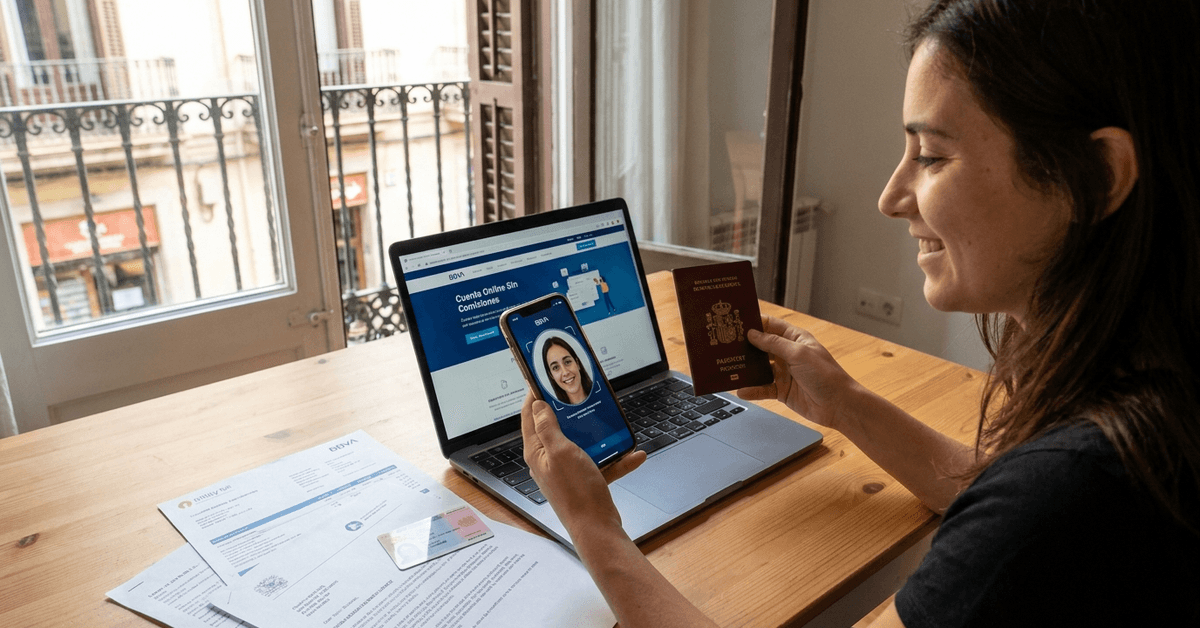
This step is where well-prepared applicants stumble. The agent may ask you to hold your passport at specific angles, tilt your face toward the camera, or read identification numbers aloud.
Some calls happen in Spanish, even at banks that advertise English-language support. And if your internet drops mid-call, the entire verification resets.
What Banks Ask During Video ID Checks
The call typically lasts 5 to 10 minutes. A representative compares your face to your ID photo, asks you to confirm personal details, and sometimes requests that you show the front and back of your document in a single continuous motion.
Dropped connections mean starting over. A stable Wi-Fi connection and decent lighting matter more than having perfectly scanned documents.
I’d recommend using the bank’s mobile app for the video call instead of a desktop browser, since BBVA and CaixaBank both report fewer technical failures through their apps.
Why I’d Pick a Traditional Spanish Bank Over a Neobank First
Every expat guide on the internet in 2026 recommends opening a neobank account as your first step. N26, Revolut, and Wise are fast, app-based, and fully available in English. The logic seems obvious: get a working account in minutes while you sort out the traditional bank later.
I think that approach is backwards for anyone planning to stay in Spain longer than six months, and the reason is specific. Spanish utility companies, landlords, and the Agencia Tributaria (tax office) often require a domestic Spanish IBAN for direct debits.
Neobank IBANs, which are typically German or Lithuanian, get rejected by Endesa, Iberdrola, and other major Spanish providers more often than expat forums suggest.
Documents Spanish Banks Accept When Applying Online
Getting documents right sounds boring until a bank rejects your application without telling you which file failed.
Banks in Spain are strict about formats, dates, and name matching. A passport scan that’s slightly blurry or a proof of address older than three months gets rejected silently.
The Address Proof Problem for New Arrivals
This friction point catches almost every new expat. A rental contract works if it’s recent and shows your Spanish address. Utility bills work too, but nobody has one if they just landed. Some banks accept a Certificado de Empadronamiento (registration certificate from your local town hall), which you can obtain within days of arriving.
Foreign-issued documents are a gamble. Some banks accept a bank statement from your home country showing a Spanish address. Others won’t accept anything not issued in Spain.
Checking the specific bank’s requirements page on BBVA or CaixaBank’s site before uploading saves a round trip through customer support.
Document Checklist for Online Applications
Have these ready in .JPG or .PDF format before starting any application:
- Valid passport, DNI, or NIE: originals scanned clearly, not photocopies
- Proof of Spanish address: rental contract, Empadronamiento, or a utility bill dated within the last 3 months
- Spanish mobile number and active email address: required for two-factor authentication and account notifications
- Tax identification number (NIF or NIE): some banks need this at application, others request it during a later compliance step
- Evidence of income: a payslip, employment contract, or university enrollment letter for students
Missing even one of these will pause the application. And no, the bank usually won’t specify which document caused the problem.
How Fees Compare: Traditional Banks vs. Neobanks in Spain
Fees are the first thing people compare, and the last thing they read carefully. The table below breaks down common costs for expats opening accounts in Spain in 2026:
| Feature | Traditional Banks (BBVA, CaixaBank, Santander) | Neobanks (N26, Revolut, Wise) |
|---|---|---|
| Monthly maintenance fee | €0 to €8 (often waived with direct salary deposit) | €0 for basic accounts |
| Card issuance | Free to €15 | Free (virtual) or €10 (physical) |
| ATM withdrawals | Free at own network; €1 to €2 outside | Limited free withdrawals; fees after monthly cap |
| Foreign currency conversion | 1.5% to 3% | 0% to 1% depending on plan |
| Spanish IBAN issued | Yes | Rarely (usually foreign IBAN) |
| English-language support | Partial (varies by branch and app) | Full English in-app |
Neobanks win on fees. Traditional banks win on compatibility with Spanish billing systems.
Fees That Show Up After the Promotional Period
“Fee-free” is a marketing phrase, not a permanent promise. Several Spanish banks waive monthly charges for the first 12 months, then quietly introduce a €3 to €8 monthly maintenance fee.
That charge sometimes disappears again if a salary or pension hits the account each month, but the minimum amount varies by bank.
Other costs that tend to catch people mid-subscription:
- Foreign currency conversion charges of 1.5% to 3% on card payments outside the eurozone
- ATM fees of €1 to €2 per withdrawal at machines outside the bank’s own network
- International transfer fees ranging from €5 to €30 depending on destination and method
- Card replacement fees of €5 to €15 if your card is lost or stolen
Checking the fee schedule on the bank’s website once a year catches changes early. Banks in Spain are required to publish their fee documents publicly, and Banco de España keeps a comparison tool for regulated fees.
Mistakes That Add Weeks to Your Timeline
I was surprised at how often BBVA and CaixaBank applications get stuck on a single mismatched accent mark in a name field.
Entering your name slightly differently from how it appears on your passport (a missing tilde, a middle name in the wrong box) triggers a manual review that can take a week or more.
Language and Technical Barriers
Technical errors are common too. Uploading a blurry scan, using an expired document, or applying from a browser that doesn’t support the bank’s verification plugin all create delays. Switching to the bank’s mobile app instead of the desktop site resolves most of these.
Language is another barrier that people underestimate. Banks like BBVA and N26 have English apps, but their terms and conditions are often only available in Spanish.
Running the contract through a translation tool before accepting is better than signing something you can’t read. Nobody wants to discover withdrawal limits or early closure penalties after the fact.
Questions People Ask About Opening a Bank Account Online in Spain
These questions come up constantly in expat forums, and a few deserve a more direct answer than they usually get.
- Q: Can a non-resident open a bank account online in Spain?
Several banks allow non-resident accounts, though features and fees differ from resident ones. Transaction limits tend to be lower, and some banks charge a higher monthly fee. Applying in person at a branch is sometimes required for non-residents, even at banks with full online onboarding for residents. - Q: How long does it take to open a bank account online in Spain?
The application itself takes 10 to 20 minutes. Approval can happen the same day for straightforward cases, or stretch to a week if manual document checks kick in. Card delivery adds another 5 to 10 business days on top of that. - Q: Do I need a Spanish phone number to open an account?
Almost every bank requires a Spanish mobile number for SMS verification codes. A prepaid SIM card from any provider works fine. Some neobanks accept non-Spanish numbers, but this can limit features like receiving OTP codes for local transactions. - Q: Is my money protected in a Spanish online bank?
Deposits up to €100,000 are covered by the Spanish Deposit Guarantee Fund (Fondo de Garantía de Depósitos). This applies to both traditional and digital banks licensed in Spain. Neobanks operating under a different EU country’s license fall under that country’s guarantee scheme instead. - Q: Can I open a joint account online in Spain?
Some traditional banks allow joint accounts through their online platform, but both holders usually need to complete the video verification step separately. Neobanks generally do not offer joint accounts on their basic plans.
Conclusion
Opening a bank account online in Spain is simple on paper but surprisingly specific in the details. The video call, the IBAN type, and the post-promo fee schedule separate a smooth setup from a frustrating one.
Getting every document formatted and ready before clicking “apply” saves more time than any comparison chart. Pick the bank that fits how you plan to live in Spain, not the one with the lowest sticker price.